


FAQ
Frequently Asked Questions
Renoplast drip edges are available in three basic colours with a satin finish: Graphite RAL 7024, Grey RAL 7037, and Brown RAL 8019.
Additionally, selected K100 and W35 PLUS drip edges are available in Black RAL 9005.
On individual request, Renoplast produces drip edges in any other colour from the RAL palette, in either satin or matt finish. Manufacturing profiles in colours other than the standard ones is subject to individual pricing.
Renoplast products are available through our network of trading partners and distributors in Poland and abroad. To find the point of sale nearest to your location, please use the search tool available on our website under the “Where to buy” tab, direct link here: https://renoplast.pl/en/renoplast-shop/shops
Balcony and terrace profiles are of uniform length and are available in standard 2-metre sections.
The Renoplast product range includes approximately 1500 products, making it often impossible for a distributor to keep the full assortment in stock. We usually dispatch standard orders within 7 business days. The maximum waiting time for dispatch is 14 business days.
For assistance in choosing one of the Renoplast systems, you can contact our team of technical advisors. You can find phone numbers on our website under the “Contact” tab in the “Technical Department” section. Direct link here: https://renoplast.pl/en/contact
Unfortunately, we do not accept orders by phone. Due to our wide range of products, we require orders to be placed via the contact form available on our website or by email. This allows us to minimize the risk of errors when processing orders.
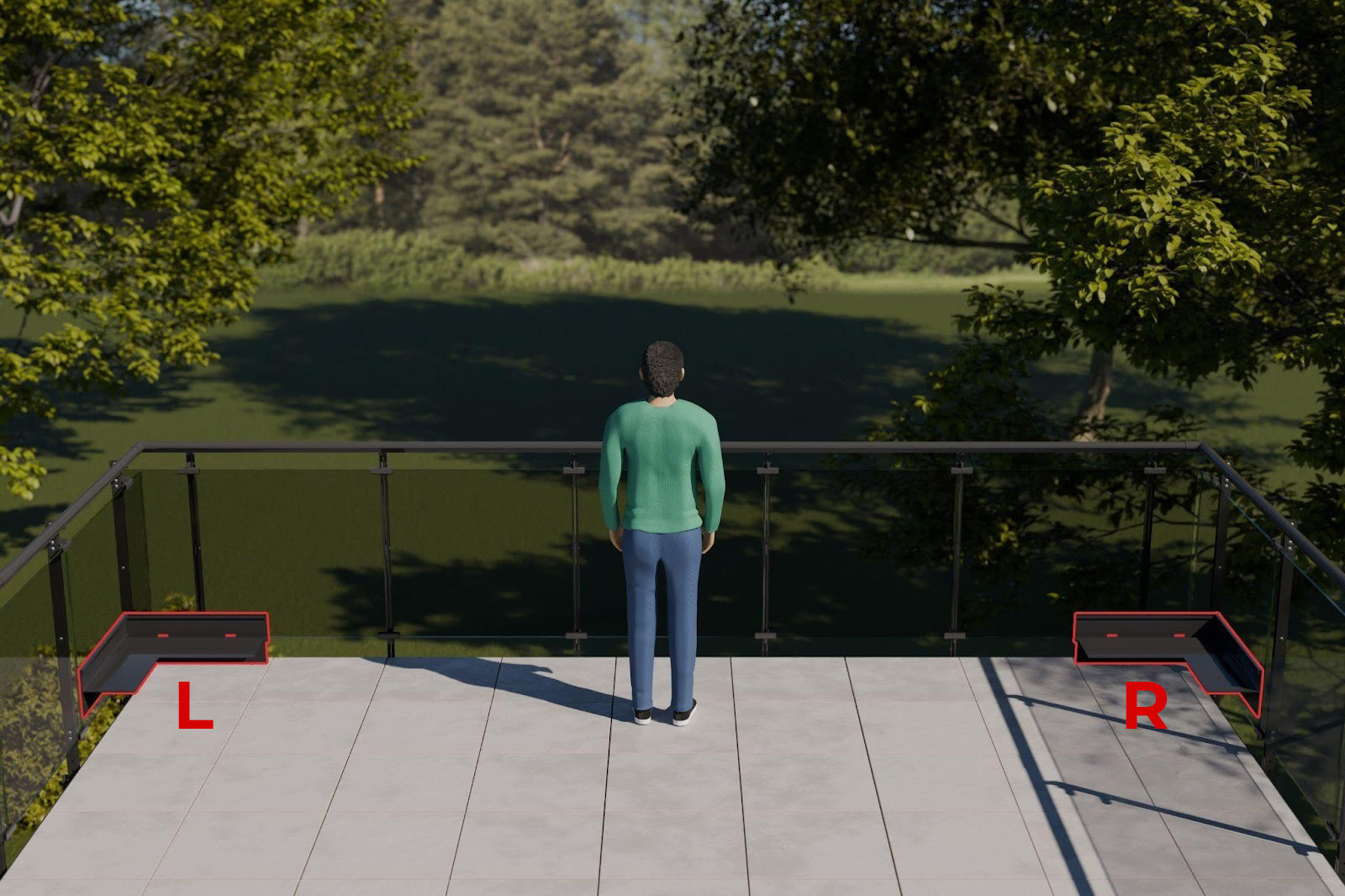
To order the K35/K35B; W35+/W35B drip edge adapter corner or left or right return piece, stand in the position shown in the figure below - with your back to the balcony door and facing the edge of the balcony - and then determine the type of corner, paying attention to the markings: L for left corner and R for right corner.
A professional tool for calculating requirements for Renoplast products is available under the “Calculator” tab. Based on the information provided by the user, the Calculator helps to calculate the quantity of materials necessary to finish a balcony or terrace using pedestal paving, tiled flooring, and resinous coating systems. Direct link to the calculator here: https://renoplast.pl/en/calculator
Yes, all terrace and balcony finishing systems offered by Renoplast can be installed by yourself. Installation is significantly easier than using traditional sheet metal flashing, and the entire process is made easier by instructional videos available on the Renoplast YouTube channel: Instructional videos
A recess is necessary to install the drip edges flush with the surface of the cementitious base. When laying the cement base layer, embed an ABS blockout strip along the eaves edge. If the base is already complete, the recess is created by milling an 8 cm wide strip along the edge of the base.
All measurements should be taken on-site, to an accuracy of 0.5 cm, as design or estimated values may differ from the actual ones. In addition to basic dimensions, i.e. length and width, it may be necessary to measure the installation height of the balcony door, its width and the depth of the recess. For terraces with pedestal paving, the slope of the base must also be measured using a spirit level. https://renoplast.pl/en/calculator
Returns of products ordered via the online store are possible within 14 days of the date of receipt of the order.
Other return requests will be handled on a case-by-case basis following contact with the technical-sales representative responsible for the given region.
The correct slope for a terrace or balcony should be within the range of 1.5% to 2%.
The slope is calculated using a spirit level, placing it against the wall and extending it in the direction of the desired fall. When the level is set for a length of 1 meter, the height between the spirit level and the screed (or substrate) should measure between 1.5 cm and 2 cm.
Renoplast drip edges should be cut using a hand saw or a mechanical saw suitable for aluminium. The use of an angle grinder is forbidden.
In case of questions or doubts regarding the status of the placed order, please contact Customer Service: orders@renoplast.pl
You can direct any technical questions regarding Renoplast products to our advisors from the Technical Department. You can find their phone numbers or email addresses under the “Contact” tab on our website in the “Technical Department” section.
Renoplast drip edges are cut at their joints. The resulting gap is filled with a permanently plastic compound, e.g. polyurethane. Such filling protects the cut edge against corrosion.
A buyer who has identified a product defect should report the complaint immediately upon discovery via mail: reklamacje@renoplast.pl
The complaint should include the order number, the designation of the product concerned, the reason for the complaint, and the preferred method of resolution.
No, Renoplast does not provide such a service, nor do we act as an intermediary in establishing contact with a contractor.
As practice shows, balconies and terraces finished with Renoplast products are durable, which means they do not require constant renovation and repairs. Choosing cheap and unproven materials results in low durability of the finished surfaces, which prove to be highly prone to failure during use. Therefore, considering the overall installation costs and the need for repeated repairs, balconies and terraces executed with Renoplast systems are highly cost-effective – ensuring real savings, safety of use, and years of peace of mind without unforeseen expenses.
No gutter brackets are required for the installation of R50 and RK65 aluminium gutter systems. The gutters are fixed to selected drip edges using stainless steel self-drilling fasteners.
• For tiled flooring: K100R, K35.
• For pedestal paving systems: W30R PLUS, W35 PLUS, W20R.
• For resinous coatings: K10R, K20R.
The main causes of cracking and detachment of floor tiles in a tiled flooring system include errors related to incorrect material selection:
• The mineral tile adhesive, sealing slurry, and grouting mortar are not intended for outdoor use.
• Tiles of excessive size were selected, which tend to crack due to internal stresses.
• Dark-coloured tiles were used, which heat up faster and cause thermal stress.
• Excessive water absorption of the selected floor tiles (permissible 3%).
• Coated steel sheet drip edges were used for finishing.
Flooring cracks are also influenced by execution errors such as:
• Lack of expansion joints in the cementitious base.
• Execution of a too thin sealing slurry waterproofing layer – inconsistent with the manufacturer's technical data sheet.
• Laying floor tiles on a too thick layer of mineral tile adhesive (usually max. 5 mm).
• Making the joint between tiles too narrow (recommended 5 mm).
• Lack of expansion joints in the flooring.
• Improper installation of drip edges.
Errors during the period of use also lead to micro-cracks, further detachment, and finally cracking of the flooring:
• Lack of periodic inspections of the flooring.
• Lack of periodic replacement of elastic sealants (SIKA recommends replacement every 3 years).
• Using strong chemicals to clean the flooring.
For pedestal paving systems laid on a slope, i.e. parallel to the base, SMART fixed height pedestals should be used. Conversely, for floors laid horizontally level, we choose RENOPAD PRO adjustable height pedestals.
Renoplast undertakes to process a complaint received from the Buyer within 14 days from the date of its submission.
W30 Profile
• Drip edge for finishing straight edges with SMART paving pedestals.
W35 Profile
• Drip edge for finishing straight and curved edges with SMART paving pedestals.
• Profile prepared for the installation of the system R50 aluminium gutter.
• Profile integrated with an EPDM collar allowing connection with the EPDM membrane.
There are several reasons for water stains appearing on the balcony underside and the building wall. The first and primary reason is the use of bent sheet metal drip edges with overlapped joints and hand-bent corners, i.e. the lack of system wall protection end caps at the building wall connection.
The most common cause of moisture appearing in a room near a balcony is a so-called thermal bridge, i.e. a place where thermal insulation has been incorrectly installed. Moisture accumulation is a natural process that occurs in the absence of insulation on balcony slabs.
Reputable manufacturers of construction chemicals offer complete solutions for executing flooring layers in tiled flooring systems. The set of recommended materials also includes material for grouts/joints. It is discouraged to mix materials originating from different manufacturers.
Both profiles, i.e. W30 and W30R PLUS, are intended for the pedestal paving system. The difference is that the W30R PLUS profile, unlike the W30, allows for the installation of system aluminium gutters R50 or RK65.
Yes, gutter brackets from other manufacturers can be installed on Renoplast drip edges, provided they are adapted to the specific mounting system.
For example, Renoplast MG75 gutter brackets allow for easy installation and unrestricted adjustment of the gutter slope. These brackets, packed in sets of 4 along with matching stainless steel screws, are compatible with 75 mm diameter gutters from Gamrat and Bryza.
No, it is not possible to glue the EPDM membrane directly to EPS or XPS polystyrene, because the solvents contained in EPDM adhesives destroy the polystyrene.
Whether to lay the paving following the slope of the base or horizontally level depends on the size of the balcony or terrace flooring and the functional requirements of these surfaces.
In general, it can be assumed that on small balconies and terraces, the paving can be laid on a slope using SMART fixed height pedestals, as this slope will be practically unnoticeable. This is an economic approach if one wishes to lower investment costs.
Conversely, on large surfaces, a better solution proves to be paving laid horizontally level on RENOPAD PRO adjustable height pedestals. However, this choice involves a slightly higher expense.
If water is leaking into the building, it means that the balcony or terrace needs to be fully reconstructed. However, before deciding on the appropriate technology for your building, please familiarise yourself with the available terrace and balcony finishing systems: https://renoplast.pl/en/terrace-patio-and-balcony-finishing-systems .
Correct drainage of a balcony or terrace relies on appropriately selected drip edges. The Renoplast offer includes drip edges for all terrace and balcony finishing technologies, and their design enables efficient evacuation of rain water runoff from the paving while ensuring full watertightness of the edge.
The joint width between tiles should comply with the technical information provided by the manufacturer of construction chemicals. Furthermore, the tile size matters: the smaller, the better, as does their colour – due to thermal stress, light-coloured tiles are recommended. In general, the joint should be 5 mm wide.
SMART fixed height pedestals and RENOPAD PRO adjustable height pedestals have the strength allowing them to be used with pedestal paving systems laid on:
• 2 cm thick porcelain pavers,
• 4-6 cm thick natural stone and concrete pavers.
Terraces with pedestal paving systems using SMART fixed height pedestals or RENOPAD PRO adjustable height pedestals should be installed in accordance with the installation instructions.
Here is a condensed work scheme based on the GRAND W60 system and SMART pedestals:
1. Substrate preparation: A slope of 1.5 – 2% is required. Create a 3 mm recess along the edge so that the drip edge sits flush with the base.
2. Drip edge installation: Cut the drip edges (using a metal/aluminium saw only!), leaving a 2 mm expansion gap. Bed them on a flexible sealant and mechanically fix using wall plugs.
3. Waterproofing: Bond the EPDM membrane to the substrate and drip edges. Precisely seal the overlaps, corners, and door threshold (using EPDM sealant).
4. Laying the paving: Lay the pavers on the pedestals. The front of the drip edge provides stable support and masks the pavers, while the bottom drain holes evacuate water.
5. Finishing (optional): Install C1 and C2 skirting trims (designed to accommodate LED strip installation!) and R50 or RK65 system aluminium gutters.
The material for thermal insulation is selected based on its compressive strength and its insulating properties. This can be EPS, XPS polystyrene, or PU foam. The minimum compressive strength of the insulation layer should not be less than 100 – 150 kPa. The thickness of the thermal insulation layer is determined by the building's thermal calculations.
In the case of 60 x 60 cm pavers, the best solution is to support them at the corners, halfway along the edges, and at the centre of the paver. This equates to 2.25 SMART pedestals per paver.
If the thermal insulation on the balcony or terrace face is 2–3 cm thick, the drip edge can be installed over the insulation. This is enabled by the design of Renoplast drip edges, as their mounting base width is 6 to 8 cm, depending on the profile type.
The problem arises when the insulation on the balcony or terrace face is thicker. This is a difficult issue to resolve, as it involves the terrace layers overhanging the wall insulation, which cannot provide stable support. Renoplast engineers are working on a system solution to this problem. If you have any questions, please feel free to contact our technical department: https://renoplast.pl/en/contact#technical-support-department
Yes, under glued tiles on a balcony, applying proper waterproofing is not only recommended but actually required.
The most common solution is the use of sealing slurry combined with waterproof sealing tapes available on our website: https://renoplast.pl/en/sealing-kit
SMART paving pedestals are fixed height, but thanks to an innovative solution using levelling discs, it is possible to level out irregularities in the base or pavers.
Balcony or terrace waterproofing is performed using materials appropriate for the selected technology.
If the terrace is constructed using the pedestal paving system, the definitely best waterproofing solution is the EPDM membrane.
If the balcony is constructed using tiled flooring laid on adhesive mortar, waterproofing is performed using sealing slurry.
In cases where the slope on the terrace or balcony exceeds 2.5%, it is recommended to use a slope corrector with RENOPAD PRO pedestals.
Renoplast manufactures drip edges designed for finishing curved edges. These are profiles produced at the factory based on a provided template replicating the edge of the eaves:
• For tiled flooring: K30, K35, K40, K100, K102, K301.
• For pedestal paving systems: W30, W35 PLUS, and W60.
• For resinous flooring: K10, K20, K20R.
Renoplast also offers profiles adapted for bending on-site:
• For tiled flooring: K35.
• For pedestal paving systems: W30, W35 PLUS, and W60.
• For tiled flooring: SC1.
• For resinous flooring: SZ10 and SZ15.
Drip edges should not be installed within the thermal insulation layer. However, Renoplast technicians can provide individual assistance to resolve this issue. In such cases, please contact the technical department via the link available here: https://renoplast.pl/en/contact
On terraces and balconies finished with pedestal paving systems, we recommend installing waterproofing using a bonded EPDM membrane system. A complete set of materials is available through the Renoplast distributor network or in our online store.
On balconies finished with tiled flooring technology, waterproofing is performed using sealing slurry, in accordance with the mortar manufacturer's instructions.
On balconies finished with resinous coating technology, waterproofing is performed using a specific system provided by the resin manufacturer. Usually, this is two-component polyurethane resin waterproofing. The installation should be carried out in accordance with the system manufacturer's technology.
Yes, material requirements for a balcony with curved drip edges can be calculated based on a technical drawing. There is no need to send a hard template to receive a quote.
No, paving pedestals should not be laid directly on polystyrene. Rigid polystyrene under the pedestals will compress over time due to dynamic loads on the balcony or terrace surface. This, in turn, will cause destabilisation of the paving.
Stairs leading to the terrace are constructed using the same technology as the terrace itself. Detailed information on how to construct terrace stairs can be found on the following pages:
• Stairs with pedestal system – https://renoplast.pl/en/stair-finishing-systems/pedestal-system
• Stairs with tile covering – https://renoplast.pl/en/stair-finishing-systems/tile-covering
• Stairs with resinous coating – https://renoplast.pl/en/stair-finishing-systems/resinous-coating
All Renoplast drip edges are factory-protected (on the visible part) with protective tape. The tape must be removed immediately after installation is complete. Therefore, there is no need to clean the profiles.
The base for the terrace system should be even, structurally sound, and without visible cracks. It is usually a cementitious base, but the substrate can also consist of a cement board or another rigid material. A waterproofing layer is laid on the base. It is recommended to perform waterproofing in a bonded system using EPDM membrane.
Absolutely, because waterproofing balconies and terraces with pedestal paving systems utilizing EPDM membrane offers nothing but advantages.
• It is highly durable: the membrane's service life is estimated at approx. 50 years.
• It possesses high flexibility, incomparable to any other material, allowing for application on irregular shapes (e.g. in the balcony door area).
• It is resistant to aggressive chemicals often used for cleaning the paving.
• It is not damaged by salt.
• In a bonded system, it is a simple solution to install, requiring no specialist equipment such as heat welders.
• The seams (overlaps) do not create ridges that would destabilise the paving pedestals standing on them.
To ensure trouble-free use of the terrace for as long as possible, whilst maintaining full functionality and high aesthetics, we recommend constructing it using the pedestal paving system, i.e. pavers laid on paving pedestals, using the Renoplast aluminium RENODRAIN channel drain at the edge. This is a user-friendly system solution that is almost fully concealed. More information here:
In the case of a thin-coat resinous paving system, the K10 or K10R drip edge should be selected (the 'R' version is designed to allow attachment of R50 aluminium gutter system).
Conversely, for pebblestone paving (stone carpet), the correct choice is the K20 or K20R drip edge (where the 'R' version allows for the attachment of the R50 aluminium gutter system).
Orders for standard products are fulfilled within 7 business days. Non-standard orders are fulfilled within up to 14 days.
If protective tape residue remains on the drip edge, it can be removed using extraction naphtha or commercially available specialist tape removers. For cleaning, use a soft cloth that will not scratch the profile surface.
The backer rod is used at the junction between selected models of drip edges and the tile edge. On one hand, it limits the consumption of the elastic sealant; on the other, it helps to drain moisture from under the paving through drainage holes.
The backer rod is also used with plinths and when creating expansion joints
In a pedestal paving system, the EPDM membrane is laid loosely on the base, without using glue.
The fundamental principle of construction law states that all materials used in construction should be suitable for their intended application.
Coated steel sheets do not provide adequate corrosion protection to shield the balcony or terrace against the interaction with mineral tile adhesives, sealing slurries or cement mortars. Moreover, the impact of a damp environment causes rapid corrosion of the steel sheet, which leads to a loss of watertightness of the edge and accelerates its deterioration.
Therefore, the use of sheet metal flashing is not an appropriate finish for a balcony or terrace.
To calculate material requirements for pedestal paving systems, please provide the basic dimensions of the balcony or terrace, i.e. length and width, as well as the paver size, which is essential for calculating the appropriate number of pedestals. The height from the base to the balcony door frame is also significant.
The significant features of Renoplast drip edges that distinguish them from the competition are:
• complete solutions for finishing balcony and terrace edges,
• solid and rigid construction of aluminium profiles,
• guaranteed full corrosion resistance,
• high quality of drip edges and approval for use in construction in Europe, confirmed by the European Technical Assessment issued by the Building Research Institute.
When constructing balconies and terraces with composite planks, two types of drip edges from the Renoplast range can be used. The W60 profile is suitable if the user wishes to mask the terrace slab edge (6 cm height). On the other hand, if the aim is solely the evacuation of rainwater from the waterproofing layer, the K301 profile will be sufficient.
Installation and operational experience shows that almost every terrace and balcony failure originates in the edge zone.
Therefore, it is crucial to use an appropriate drip edge, matched to the specific finishing technology.
Renoplast offers complete, system edge treatment solutions designed for all technologies used in the construction market.
The key to a watertight balcony edge lies in correctly selected materials and professional workmanship. Regarding drip edges, Renoplast provides a 5-year warranty on their corrosion protection coatings. The high quality of the products on offer is also confirmed by international certificates:
• Qualicoat (since 2019): Guarantees that the paint finish meets rigorous standards for hardness, adhesion, and UV resistance.
• Qualicoat SEASIDE (from 01.2026): This is the highest protection standard, achieved through advanced preparation of the aluminium surface. It protects the profiles against corrosion even in extreme conditions (high humidity, saline air, smog).
• Durability and reliability: Balconies and terraces finished with Renoplast systems ensure years of trouble-free use without the need for repairs.
• Comprehensive systems: The customer receives a set of functionally and materially compatible components – rather than a single product – which eliminates the risk of installation errors.
• Superior aesthetics: Renoplast products are characterised by a superior aesthetic finish that retains its visual appeal for years.
• Certified quality: All products hold documents issued by the Building Research Institute (ITB), confirming safety and compliance with construction standards.
• Time and money savings: Thanks to the highest "Seaside" class anti-corrosion protection (included as standard), you avoid the cost of frequent balcony and terrace renovations.